
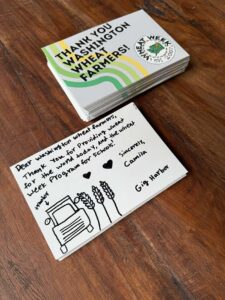
At the Washington Grain Commission (WGC) office, there are stacks of postcards from students across the state. Covered in drawings and filled with new knowledge, these postcards come from students in Washington excited to share what they learned during Wheat Week.
 This fall, Wheat Week will celebrate its 20th anniversary, two decades of impact and achievement. Run by the Franklin Conservation District and funded by the WGC and, recently, Dairy West, Wheat Week is a five-lesson program for students in Washington state. At its inception, Wheat Week was designed to thoughtfully engage with fourth and fifth grade students, especially those who may not have firsthand experience with wheat, agriculture, and conservation.
“Wheat Week educators travel to schools all over Washington state delivering five fun and engaging one-hour lessons over the course of a week,” said Liz Scully, a Wheat Week educator. “These standard-aligned, hands-on lessons all
focus on wheat and conservation, helping students learn about the importance of agriculture in Washington. Each day has a different focus, including systems, water and soil conservation, DNA, and energy.”
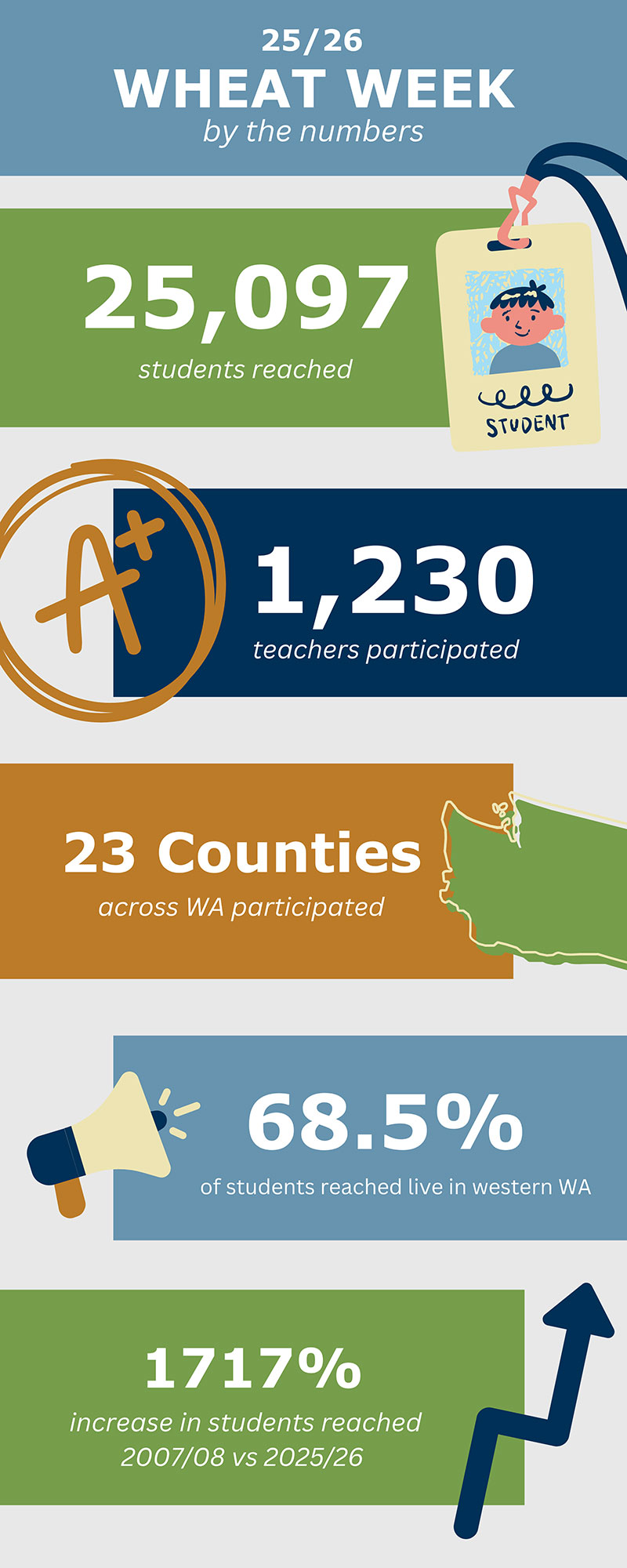
Throughout the 2025-26 school year, Wheat Week reached 25,097 Washington students in person and through the online Wheat Week program. The program was utilized by over 1,200 teachers in 23 counties across the state. More than 68% of the students reached by Wheat Week live in Western Washington.
During Wheat Week’s first school year, 1,381 students were reached, and Western Washington was not included in the program. From that first year to the 2025-26 school year, there has been a 1,717.3% increase in reach.
The Wheat Week curriculum is skillfully designed to invite active participation and engagement from students throughout the course. Students build their own terrarium, plant wheat seeds, learn about the water cycle through hands-on activities, and explore different soil particle sizes. Students are also invited to thresh a head of wheat, make wheat gum, and extract wheat DNA, a favorite activity among teachers and students alike.

Wheat Week.
“Wheat Week is an invaluable opportunity for students to engage in environmental literacy,” said Riley Gillan, a Wheat Week teacher. “Whether they get interested in our DNA extraction lesson and decide they want to be an agronomist — yes, it happens weekly — or they really enjoy getting their hands dirty and want to become a farmer, wheat is the vehicle for their learning.”
Each activity serves a larger purpose. Building the terrarium and planting wheat allows students to see their hypotheses in action. By choosing how many seeds to plant and how much water to use, students get to see the real-time impact of their choices.
As they study the water cycle, learning how water moves from the soil to the wheat plant, the games students play help tangibly illustrate the never ending water cycle. Learning through play, students better understand how water conservation benefits all living things.
Studying soil particles gives students an understanding of erosion, and extracting wheat DNA helps illustrate the connection between growers and scientists who work in tandem to create great wheat. Threshing a head of wheat helps illuminate the path that a stalk of wheat takes to become the food that Washington children eat daily.
With every element of this multifaceted approach working together to expand students’ worldview, wheat goes from something students know of to something students know about. Their understanding of the wheat foods they consume daily increases, and a new respect for Washington wheat farmers grows.
During the COVID-19 pandemic, when classrooms shut down, Wheat Week had to pivot. With classrooms closed and schools participating in online learning, Kaelber knew that Wheat Week needed to move online too.
Reflecting on that time, Kaelber explained, “My team and I got creative! We took a lot of online training on how to teach students online, and we created a do-it-yourself version of Wheat Week that we could deliver to teachers, and they could teach themselves during COVID. We created online instructional videos to accompany the supplies we would send or deliver to the teachers so they could give students a modified, slimmed-down version of our in-person Wheat Week program.”
The hope was to reach 5,000 students during lockdown. Instead, the Franklin Conservation District sent out over 26,000 kits to teachers and students across the state.
Today, the DIY Wheat Week program is still available online. This program offers a flexible approach to learning for students who are homeschooled, in a hybrid-learning situation, or teachers who are unable to sign up for Wheat Week in person.
The DIY program, though condensed, still shares critical information and an activity kit filled with all the materials needed to explore wheat, agriculture, and conservation. To sign up for the online Wheat Week program, visit the Franklin Conservation District website at franklincd.org.
Education has always been a pillar of the WGC’s mission, and that mission includes providing the rising generation with accurate, accessible information about wheat and agriculture in Washington.
When you introduce a child to wheat through education, especially a child who may not have agricultural knowledge or background, you open the door to how their food is made, illuminate the food systems in progress all around them, and highlight the critical role that agriculture plays in Washington. Wheat education goes beyond highlighting wheat nutrition and health benefits; it’s about contextualizing crops in a way that expands student knowledge of agriculture’s role in society.
Washington state produces over 300 crops, and agriculture is a multibillion-dollar economic driver here, but as a society, we are increasingly removed from agriculture.
Wheat Week seeks to remedy that problem at the source. Julie Fredrickson, a teacher at Shoreline Elementary, shared the impact of the Wheat Week program on her students.
“Our school district shares a border with the Seattle School District, and we are right on Puget Sound, so our kids don’t have firsthand knowledge of farming and the importance of the farms in our state. Watching the videos of the kids being interviewed about their family farms, the equipment used, the processes, and what they produce is all pretty foreign to our ‘city kids,’ but such great learning,” she explained.
Fredrickson reiterated that the Wheat Week Program, especially with the added partnership of Dairy West, “has also helped students to better understand that food doesn’t just ‘appear’ at the store or on their table. It gives them a better understanding of what they are eating and what it took to make it ready to eat.”
“Wheat education is so valuable because it helps students to understand the journey their food takes from the farm to the table and the many players involved in that process,” Scully said. “It helps them to develop an appreciation for the farmers and all of the other people who make it possible to feed our communities. It also helps students understand some of the challenges involved in this process and the importance of conservation of our natural resources, which will help cultivate thoughtful decisionmakers in the future.”
The undertaking of Wheat Week requires a tremendous amount of time and effort from the Franklin Conservation District and Wheat Week educators, but that effort leads to understanding.
“I believe the long-term benefit of the program is exposing thousands of students and teachers each year to agriculture, farming, and wheat in Washington state,” Kaelber said. “With Wheat Week, we put a wheat stalk and kernels in the hands of those students (and even teachers), and we see the light bulb go off in their heads! They begin to understand that flour used to make their food is a wheat kernel first, grown on a large field some where by a farmer who invests their blood, sweat, and tears into bringing a successful crop to market each year. They understand farmers feed the world, and their food doesn’t just come from a grocery store.”
The WGC offers its heartfelt congratulations to the Wheat Week program for reaching this significant 20 year milestone.