

Cook’s curiosity about root diseases of wheat, particularly Fusarium root rot, always led him to their practical implications for farmers. Early on, he focused on how the disease affected wheat growth and yield. In studying Fusarium, a disease that impacts wheat growth and yield, Cook found that excessive nitrogen use — intended to boost yields and control the disease — actually weakened wheat straw, depleted soil moisture too quickly, and stressed plants, making them more susceptible to Fusarium.
Cook’s advice to growers was to back off on nitrogen application, and that advice led to soil testing and measured application of nitrogen. With appropriate nitrogen use, Fusarium was easier to control.
As his work helping farmers battle Fusarium began to wind down, Cook started looking for something new to study. It was, surprisingly, a paper he read out of the Netherlands that held the key to his next area of study. A paper in which the beginnings of a hypothesis began to take root.
After World War II, Dutch farmers repeatedly planted wheat in the same fields to increase food production and noticed that diseases such as take-all declined over time. Take-all, like Fusarium, negatively impacts wheat yield and growth and is caused by a fungal pathogen. Led by curiosity, Cook and British scientist Peter Shipton located a wheat field near Quincy, Wash., where wheat had been grown continuously for 12 years, to investigate whether the effect had broader applications.
The two scientists collected soil in five-gallon pails from the continuous wheat field in Quincy and from a field across the way with no history of monoculture, sometimes referred to as continuous wheat. Studying the soil samples, take-all was not found in the monoculture wheat field, but it was found in the field just across the way. The scientists began devising a test.
Recounting the experience later, Cook stated, “This was the most important experiment that I’ve done in my career.”
Determined to test the soil’s natural resistance to take-all after several years of continuous wheat crops, a WSU test plot was secured. The test plot’s soil was fumigated to give the scientists a clean slate to start with. Fumigating the soil allowed whatever organisms were living in the soil from the Quincy field to have free access to the new habitat with little competition.
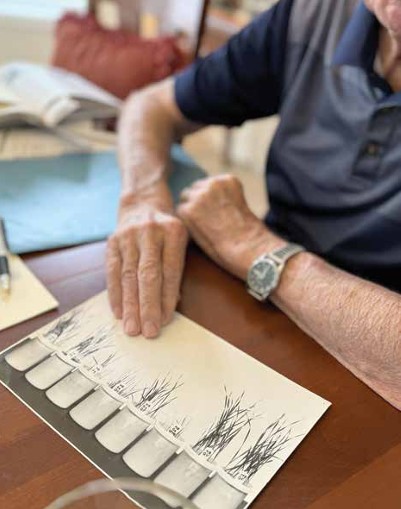
As recounted in his book, “Untold Stories: 40 Years of Field Research on Root Disease,” “a simple, four-quadrant experimental design was used to test for both carryover-inoculum and suppression, if any, of the take-all pathogen. This involved fumigating half of each main plot with methyl bromide to eliminate carryover inoculum of the pathogen and render the soil fully conducive to take-all, while the other half was left natural.” Spring wheat was then planted across the subplots. Each year the soil was studied, and yields were measured.
Cook and his team carefully watched these plots for several years, testing the soil for take-all. As they tested each plot, year after year, a throughline became evident — growing continuous monoculture wheat led to natural take-all decline, just like Cook had hypothesized was happening in that first field in Quincy.
As explained by Dr. Sieg Snapp, associate dean of research for WSU’s College of Agricultural, Human, and Natural Resource Sciences, “Many researchers I worked for as an undergraduate were inspired by Dr. Cook, who was the first to identify what became known as ‘take-all decline.’
“This is a unique phenomena where, over time, given the right conditions, a beneficial bacteria (a Pseudomonas species) could become dominant and produce an antibiotic that suppresses the fungus that causes take-all. This interaction of micro-organisms in the soil is foundational knowledge for the entire field of soil health, which has recently grown to a global movement through interest by growers and scientists in regenerative agricultural practices.”
As the study continued, Cook and his team discovered that when crop rotation was implemented in a continuous wheat field, the soil lost its natural take-all suppressant, though Cook importantly noted that there was “evidence that a three-year grass mixture will similarly maintain some level of suppression to take-all.”
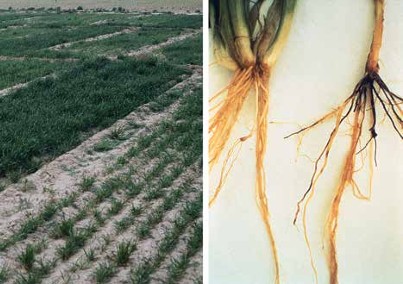
prior to planting. On the right, take-all on an adult wheat plant, with diagnostic blackening of the
subcrown internode and mainstem only. Photo courtesy of R.J. Cook.
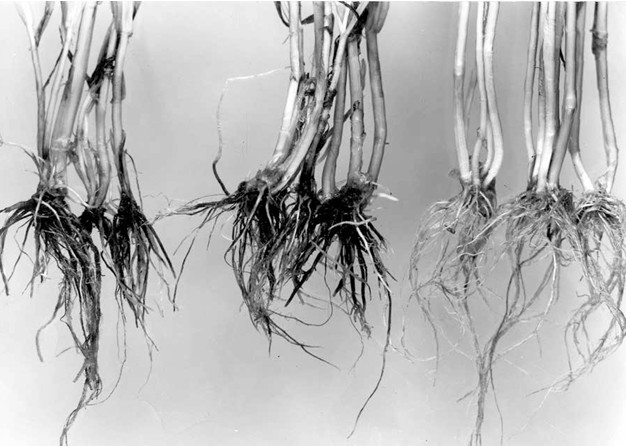
Cook summarized in his book, “I always made the point that it was best to use crop rotation, but that growing continuous monoculture wheat did something as well that we still did not understand, other than the effect is biological and transferable. My primary message was that take-all suppression after 15 years of continuous wheat was almost as good as fumigating the soil in terms of take-all.”
Cook, joined by his entire team, authored an article for the Proceedings of the National Academy of Sciences (PNAS) on the role of antibiotic-producing bacteria and the suppression of take-all with continuous monoculture wheat.
The article was selected by Philip Abelson, renowned scientist and editor of Science Magazine, for an editorial on plant pathogens in soil, drawing on the PNAS paper by Cook to make a case for the importance of soilborne pathogens of food crops, what he described as “safeguarding plants against the biological warfare that rages in soil.”
Abelson went on to describe to Science Magazine’s international readership the role of antibiotic-producing bacteria in the development of take-all suppressive soil within continuous wheat fields.
While crop rotation is a critical part of fostering healthy soils, it must be balanced with practices that assist with disease control. The right protocol will be different from farm to farm, from year to year. Knowing that take-all can be naturally suppressed by growing continuous wheat is another tool growers can use to best plan for their farms.
Dr. Cook’s legacy expands well beyond his work on take-all, beyond his dissertation on Fusarium, beyond his work revealing the genetic potential of wheat.
Cook was awarded the Guggenheim Fellowship in 1973, and in 1993, Cook became an inducted member of the National Academy of Sciences. In 1998, the Washington Grain Commission endowed the R. James Cook Endowed Chair in Wheat Research in his honor, most recently held by Dr. Ian Burke.
Cook Agronomy Farm was named in his honor in 2000.
In 2011, Cook was awarded the highly prestigious Wolf Prize in Agriculture for “seminal discoveries in plant pathology and soil microbiology that impact crop productivity and disease management.” He is one of 41 Americans to have ever been awarded a Wolf Prize.
Among Cook’s nearly innumerable achievements sit over 200 peer-reviewed articles, two books, several U.S. Department of Agriculture awards, thousands of hours spent mentoring, and thousands more spent researching in the field.
His work was tireless; his accomplishments vast. But perhaps the most impactful part of Dr. Cook’s incomparable legacy cannot be recognized by an award or a hall of fame induction.
Dr. Cook is widely known among peers and growers alike for being someone thoughtful in his approach and unfailingly generous with his information. Cook’s scientific achievements changed the way researchers understand wheat diseases and soil biology. Yet those who knew him best often remember something less tangible: his willingness to share what he learned.
Growers trusted him because he translated science into practical solutions. Students sought him out because he made time for their questions. Colleagues remember a scientist who advanced his field while lifting others alongside him.
Beverly Cook noted that growers “always came out for Jim (at field days),” because Cook had a particular knack for sharing his research in applicable ways that directly benefited the grower he was talking to.
Yes, Dr. Cook’s scientific advancements opened doors for future researchers. His research fundamentally changed the wheat world in more ways than one, and standing alongside every one of his accomplishments is a story about a fellow researcher he went well out of his way to help, a grower whose questions he happily answered, a student he lent advice to.
“I was an undergraduate student at WSU in the early 1980s, where I had the opportunity to interact with Dr. Cook as an agronomy student,” said Snapp. “He was always generous with his time and would talk with me about his research on topics like harnessing biology to tackle big challenges. His work on discoveries that protected wheat health inspired me to investigate seed coatings to protect against disease. I interviewed him about this in 1982, which led to an article that was highlighted by the American Society of Agronomy. I started to dream about becoming a scientist, which he encouraged me to pursue. His systems perspective has informed my entire research career, where he developed actionable management strategies based on the best science that armed farmers with knowledge to address real-world problems.”
Today, Cook’s legacy lives not only in research papers, awards, and institutions that bear his name, but also in the fields that continue to thrive because of his discoveries and in the researchers, growers, and students who carry his curiosity forward. Like the wheat stretching across the Palouse, the impact of his life’s work continues to grow.