Washington grain growers have been particularly impacted by the past several years of weather, supply chain issues, input costs, global COVID-19 pandemic uncertainties and outcomes, transportation and shipping costs, labor affordability, federal farm support policies, and other market/trade disruptions.
These are not new problems in agriculture, but if the frequency of these major challenges is any indication of more to come, it is clear we are behind and need to build on our strengths while improving our resilience to sustain farm economies in the medium and long term. While macroeconomic disruptions are not issues that Washington farmers can out-maneuver year to year, Washington’s current and future rain-fed grain production potential remains among the most reliable and versatile in the world.
Currently, around 90% of Washington wheat production is exported. Primarily soft white wheat or the club wheat-enriched Western White subclass is exported to Asian, Latin American, and some Middle Eastern countries for use in breads, crackers, snacks, and pastries. Thus, over 85% of planted acres in Washington currently are sown to the same winter and spring wheat class(es). Our reliable and high-quality supply that meets the strict quality requirements of portions of our customer base has provided a relatively stable market for Washington growers, with some price advantage and reliable exports.
The challenges of realizing more diverse and economically resilient Washington grain systems are substantial, though. This challenge is now further complicated by variable and declining financial support at the federal level for traditional land-grant research and Extension efforts due to policy priorities and private-sector investment during extended periods of low agricultural returns. With this in mind, we have been actively seeking alternatives to enhance our ability to contribute to our grain systems.

In September 2025, a team led by Kevin Murphy of the Washington State University (WSU) Breadlab was notified of a successful application for nontraditional research and Extension support from the Washington Research Foundation (WRF), a Seattle-based private foundation founded in 1981 that “envisions Washington state research institutions delivering innovations that transform our lives.”
We are currently several months into a new five-year, $19 million project to lay the groundwork for new product and market opportunities. This effort is a collaboration between WSU-based wheat and barley scientists; soil scientists; wheat quality and food science product development faculty; human digestive-system biologists and food epidemiologists; and University of Washington food science, nutrition, and policy scientists, with both financial support and collaboration from the Washington Grain Commission, the Washington Pulse Crop Commission, USA Dry Pea & Lentil Council, The Land Institute, Port of Skagit, MGP Ingredients Inc., Brabender/Anton Paar, American Heart Association,
Rockefeller Foundation, and the Meter Group.
Of the $19 million, $10 million comes from WRF, with the additional $9 million in matching funds coming from a combination of in-kind and cash contributions from the institutions mentioned above, WSU, and the University of Washington.
We aim to develop new and novel nutritionally enhanced varieties while improving agronomic and nutrient management information and eventually increasing the availability and accessibility of these grains and grain-based food products. For Eastern Washington grain growers, this means systematic measurement and tracking of the flow of nutrients from our test plot fields to initial quality selections and eventually, large-scale production to human consumption.
The Washington Grain Commission’s long-term support of WSU’s variety testing program (VTP), U.S. Department of Agriculture’s (USDA) Western Wheat Quality Lab (WWQL), and wheat breeding programs features heavily in these plans, and we have now started systematic measurement of both beneficial mineral nutrients and other nutritionally relevant aspects of grain from a plant and human nutrition perspective and undesirable heavy metal levels in both soil samples and harvested grain samples from VTP and breeding plot work across the region.
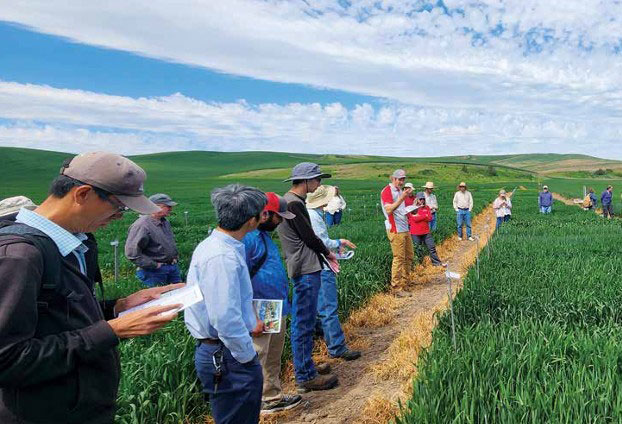
WSU’s Variety Testing Program, WWQL Cultivar Development Manager Alecia Kiszonas, and soil scientist Shikha Singh at the Lind Dryland Research Station, are leading the charge to better understand our soil and grain mineral dynamics. Because some of the most important changes in grain composition, including mineral contents, oils, fiber, and antioxidants, are variable among varieties and selectable by plant breeders, WSU grains breeders, Bob Brueggeman, Arron Carter, Kim Garland-Campbell, and Mike Pumphrey, are working in concert with soil and cereal scientists like Girish Ganjyal, Emily Klarquist, and Amber Hauvermale to characterize and improve the grain nutritional composition in new varieties. Royalty income generated from current WSU commercial varieties was reinvested in this effort to provide some of the matching funds for this expanded breeding effort.
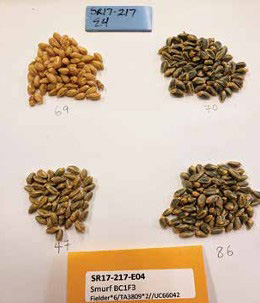
The expanded research team will collectively evaluate nutrient-dense crop varieties for key indicators of human health and consumer acceptability, followed by epidemiologic and economic research that focuses on community and population-level impacts of the foods produced. Promising existing and newly developed crop varieties with enhanced health and nutritional traits will be developed into nutritious, flavorful, and affordable food products.
Washington grain growers are uniquely positioned with sophisticated seed production and grain handling systems, the ability to grow winter and spring versions of cereal crops, diverse production areas, well established research teams, and close relationships with research, Extension, and private sector supporters. As we have in the past 130 years, we will continue to work with our industry partners and, broadly, with our stakeholders to develop food products to add value to a more resilient grain system in the future. Perhaps the greatest limitation to many value-added specialty grain products has been their lack of inclusion in high-octane research programs.