2025 crop had a lot to centend with, from snow mold to hot, dry July
We are well into the 2026 winter wheat season. After an unusually warm winter, the winter wheat is up to two weeks early in some locations. The mild winter increased the incidence of stripe rust, Hessian fly, wheat mite, and wheat soil-borne mosaic virus. Even with seven months behind us, a lot can still happen to the winter wheat crop during the 10-month growing season.
This was evident in the results of the 2025 Washington State University (WSU) Extension winter wheat trials. Dry weather during planting in the fall of 2024 impacted emergence at Lind and Almira. Snow mold left us little to look at in Douglas County. A sudden cold snap in February 2025 severely damaged some varieties, especially at Harrington, Ritzville, and Walla Walla. The hot, dry July terminated grain fill at Pullman; grain was shriveled, with low test weight and high protein at harvest. High input costs and low prices continued to plague production.
Things could have been worse, however, as winter wheat acreage increased slightly over 2024, and the state’s average yield was close to normal at 68 bushels per acre (compared to 70 bushels per acre in 2024). Much of the steady production is due to farmers’ skills. Another major factor is the quality of the wheat varieties. The WSU Extension wheat trials evaluate current and potential new varieties from all major breeding entities in both the public and private sectors. The mission of the variety trials is to generate and report high-quality, accurate data on variety performance, representing the major wheat growing regions of Washington.
The total winter wheat trial effort is large, including over 35 separate yield trials throughout Eastern and Central Washington. The soft winter wheat varieties and experimental lines were divided into low (less-than-16 inches) and high (greater-than-16 inches) annual rainfall zones. Entries were grown in their most representative zones. The CLOAX trial consisted of soft winter wheat carrying Clearfield or CoAXium herbicide resistance.
Â
For consistent fertility management, the hard winter wheat trials include hard red, hard white, and herbicide resistant hard wheat varieties. Data from the 2025 soft white and CLOAX trials are summarized by location within the low (less-than-16 inches) and high (greater than-16 inches) rainfall zones. The hard wheat trials are summarized across all rainfall zones because the high rainfall zone included only two locations. Only entries grown at all locations within a rainfall zone were included in the summary tables. Complete data is available at the Washington State University Small Grains Variety Testing website (smallgrains.wsu.edu/variety).
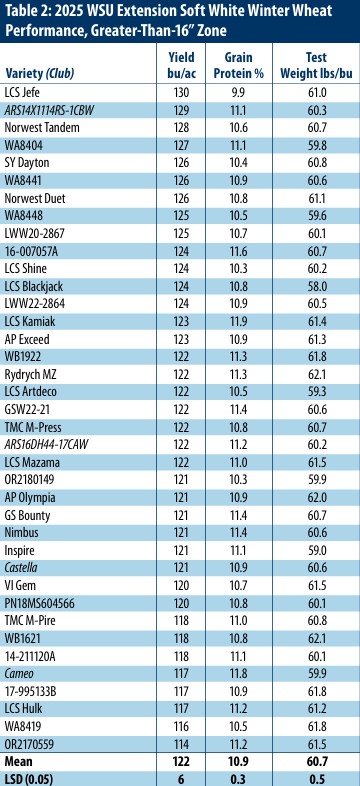
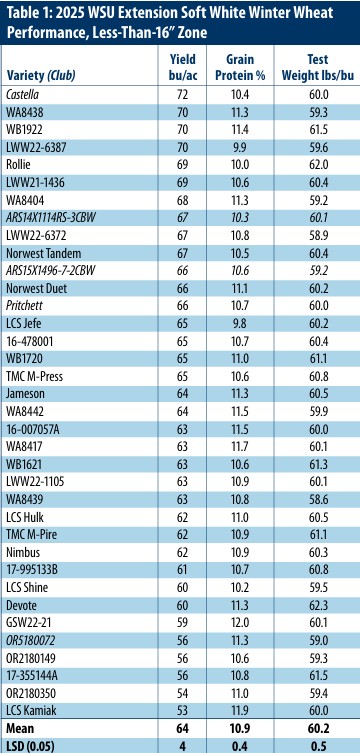
In the soft white winter wheat trials for the low (less than-16 inches) rainfall zone, the top performers included the club wheat, Castella, and the soft white wheat, Rollie, with several others ranked above average (Table 1). Several lines performed well in the high (greater-than-16 inches) rainfall zone, including LCS Jefe, Norwest Tandem, SY Dayton, Norwest Duet, LCS Shine, and LCS Blackjack (Table 2). Average grain yields were 64 bushels per acre in the low rainfall trials, but almost double at 122 bushels per acre in the high rainfall trials. The averages of protein and test weight were similar across the rainfall zones.
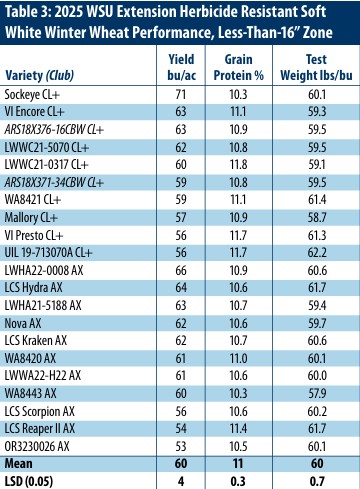
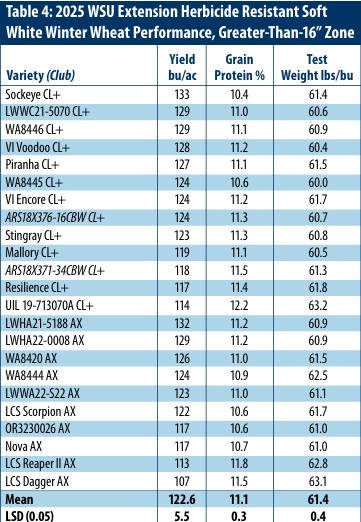
Sockeye CL+ had the best yield among the Clearfield lines in the low-rainfall CLOAX trials (Table 3). A group of lines with the CoAXium trait, LCS Hydra AX, Nova AX, and LCS Kraken AX, performed similarly. In the high rainfall zone, Sockeye CL+, VI Voodoo CL+, and Piranha CL+ were the best Clearfield lines, and LCS Scorpion AX and Nova AX were best in the high rainfall zones (Table 4). Yields of the CoAXium lines were slightly lower than those of the soft white wheat and Clearfield lines, but several experimental entries are doing well.
As with soft white wheat, the average yields of the high rainfall CLOAX trials were double that of the low rainfall trials. The average test weight of the CLOAX lines was slightly low in the low rainfall trials, while the average protein was slightly high in the high rainfall trials.
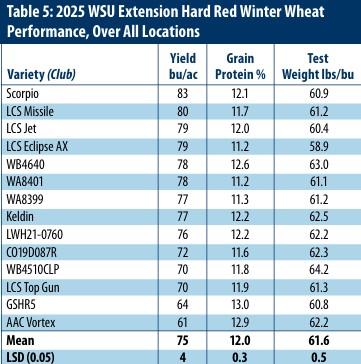
The top performers across the hard wheat nurseries included Scorpio, LCS Missile, LCS Jet, and LCS Eclipse AX (Table 5). Scorpio and LCS Jet had slightly low test weights, while the protein of LCS Missile and LCS Eclipse was slightly low. The average yield was better than the state average yield at 75 bushels per acre, protein averaged 12%, and test weight averaged 61.6. Several of the new experimental lines had competitive grain yields in all trials, so stay tuned for new releases (Tables 1-5).
The 2026 winter wheat trials were planted in the fall of 2025. The variety testing team has visited all sites, and most look good, though some trials are affected by variable emergence due to dry soils at planting. All have been sprayed with fungicide to control stripe rust.
Staffing for the WSU variety testing program is changing in 2026. The 2026 trials are currently managed by Mike Pumphrey and Kim Garland Campbell until a new project leader is hired. WSU technicians Patricia DeMacon, Vadim Jitkov, and Alex Brown manage the day-to-day activities. Our Dryland Extension Team, Aaron Esser, Morgan Menaker, and Rachel Wieme developed the summer field day and plot tour schedule (see page 48 for schedule). We are grateful for the support
of the Washington Grain Commission, the Variety Trial Advisory Committee, and all the farmers who use the data.
Full results from the 2025 winter wheat trials are posted on the WSU Small Grains website at smallgrains.wsu.edu. This site will take you to location maps and GPS coordinates for all 2026 trials, as well as current and archived data. You can also join the Variety Trial PrelimData listserv to receive yield data within a week of harvest.
Contact the dryland extension team if you have questions about tours or field days. All other questions about the trials can be submitted through the variety testing website. Let’s hope the next five months remain kind to the 2025 wheat crop.
This article originally appeared in the May 2026 issue of Wheat Life Magazine.
Kimberly Garland-Campbell
Research Geneticist and Club Wheat Breeder, USDA-ARS, Washington State University