
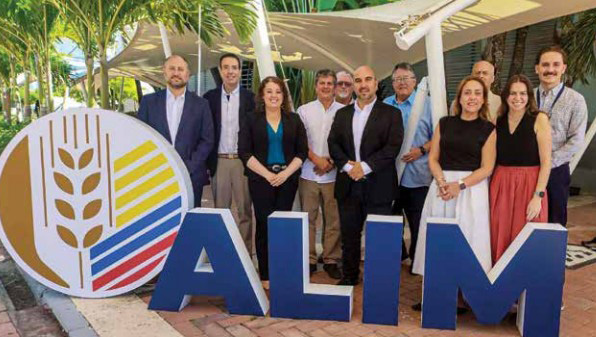
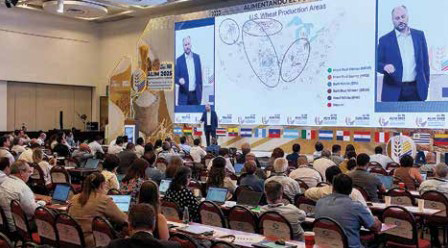
In late November, I traveled to Cartagena, Colombia, to attend the 43rd Annual Conference of the Latin American Association of Milling Industries (ALIM). The event brought together more than 500 participants, including hundreds of wheat millers, bakers, processors, equipment suppliers, and commodity representatives from across Latin America. For Washington wheat, having a presence in this growing market is vital. ALIM is not only about moving wheat today, it’s about protecting and building demand for tomorrow. It is a place to hear directly from customers about what is changing in their businesses, and what they will need from wheat suppliers moving forward. It is also a place to hear from our competitors — Canada, Argentina, Australia — about their harvest outlooks, trade policy shifts, sustainability messaging, and expected export volumes.
A consistent theme throughout the conference was risk. Latin American millers are operating in an environment shaped by geopolitical conflict, trade uncertainty, freight disruptions, and inflationary pressure, all of which affect their ability to source wheat predictably. From conflicts in the Black Sea and disruptions in the Red Sea, to shifting trade policies and volatile freight markets, buyers are focused less on chasing the lowest price and more on securing a reliable supply. For Washington wheat, this matters because reliability, transparency, and a stable export system are increasingly part of the value customers are buying, in addition to protein, falling numbers, or test weight.
Another message that came through clearly at ALIM was how quickly sustainability expectations are moving in wheat markets, and how aggressively some competitors are responding. Canada, in particular, is already quantifying and promoting the carbon footprint of its wheat using life cycle assessments, and those numbers are being used directly in conversations with millers and food companies in Latin America. Sustainability is no longer a future concept or a niche premium, but for many customers, it is becoming a basic requirement for doing business. What stood out, however, was that millers are not just asking about sustainability in general, they are asking how it works across the entire value chain, including what value, if any, flows back to the farmer.
For Washington growers, this conversation should feel familiar. Many of the practices customers are asking about — reduced tillage, diverse rotations, efficient fertilizer use, and strong environmental stewardship — are already common across much of our wheat production. The challenge is not practice, but proof. As sustainability becomes more data-driven and more visible in the marketplace, customers are looking for quantified, comparable information they can use in their own reporting and brand commitments.
Despite economic pressure and ongoing inflation across much of Latin America, one thing was clear at ALIM: wheat-based foods remain central to daily diets. Bread, pastries, and baked goods continue to be staples, in part, because food carries emotional value, comfort, tradition, and small indulgences during uncertain times. While consumers are more price-conscious, they are not willing to sacrifice quality, which keeps functional performance at the center of purchasing decisions. For Washington wheat, this reinforces the importance of consistency. When millers and bakers are trying to manage costs, reduce waste, and deliver reliable products to their customers, wheat that performs the same way every day continues to earn a place in the blend.
Another clear signal from ALIM was how quickly milling technology is advancing, and how that changes what millers need from wheat. Discussions around automation and artificial intelligence focused on practical applications — energy efficiency, quality monitoring, food safety, and labor training — rather than abstract concepts. As mills rely more heavily on digital systems, consistency in wheat quality becomes even more important because variability creates inefficiencies and added costs. There was also strong interest in expanding product flexibility, including the use of soft white wheat flour in applications like pasta, made possible by improvements in processing and drying technology. For Washington soft white wheat, these developments point to opportunities beyond traditional uses, particularly in multiproduct mills looking for reliable, adaptable inputs.
ALIM also reinforced just how competitive the global wheat market has become, particularly in Latin America. Argentina is expanding production and export capacity, supported by favorable freight and a renewed focus on pro-export trade policy. Australia continues to position itself as a reliable supplier of clean, white, food-grade wheat with strong quality assurance systems. At the same time, freight costs and logistics remain volatile, shaped by geopolitical disruptions and shifting trade flows. For buyers, futures prices are only one piece of the puzzle, as basis and freight reflect confidence in an origin’s ability to deliver. This is where Washington wheat continues to differentiate itself through dependable logistics, established relationships, and a supply chain that performs when markets are stressed.
For the Washington Grain Commission (WGC), trips to ALIM ultimately serve one purpose: protecting and growing demand for Washington wheat. The conversations held at events like this help shape how wheat is sourced and priced in the months to come. They also inform WGC on how best to invest grower dollars for maximum impact. Market development is not about chasing short-term sales; it is about staying present, listening early, and making sure Washington wheat remains relevant as customer expectations evolve. What I heard in Cartagena was encouraging, and it also reinforced the need to stay engaged. In a market defined by volatility and competition, demand does not take care of itself. It has to be earned and maintained.