
Washington’s total wheat production in 2025 reached 141.5 million bushels (3.8 million metric tons or MMT), representing a 1.5% decline from 2024 but 12% above the five-year average. Winter wheat continued to dominate production, accounting for 86% of the state’s total, while spring wheat held steady year-over-year. In contrast, barley production declined sharply by 48%, driven by lower profitability, reduced demand for malting barley, and the closure of regional processing facilities. Despite these fluctuations, Washington maintained 7% of total U.S. wheat output, underscoring its continued leadership in quality and reliability. 
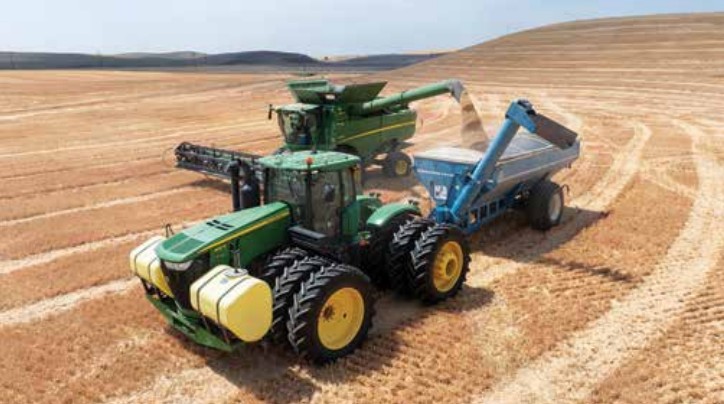
Washington wheat overview:
- Total wheat: 141.5 million bushels (3.8 MMT), -1.5% year over year, +12% vs. five-year average (125.9 million bushels or 3.4 MMT). Washington accounted for 7% of U.S. production.
- Winter wheat: 121.7 million bushels (3.3 MMT), -1% year over year, +14% vs. five-year average. Yields averaged 68 bu/ac (70 bu/ac in 2024).
- Spring wheat: 19.7 million bushels (537.2 TMT), -6% year over year, +1.5% vs. five-year average. Yields averaged 42 bu/ac (43 bu/ac in 2024).
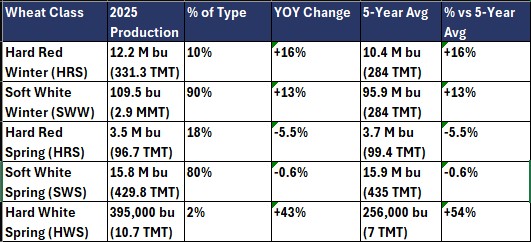 U.S. total wheat production is projected at 1.9 billion bushels (54 MMT), a 0.3% increase year over year and a 9% gain over the five-year average.
Washington barley overview:
- Production: 2.4 million bushels (63.3 thousand metric tons or TMT), -48% year over year, and 37% below the five-year average (3.8 million bushels or 103.8 TMT).
- Share of U.S. production: Washington accounts for 1.7% of national barley output, a 1.5% decline from 2024.
Total U.S. barley production for 2025 is projected at 140.8 million bushels (3.8 MMT), a 2% decline year over year and 8% below the five-year average.
Despite modest yield reductions, Washington’s wheat sector remains strongly supported by robust winter wheat performance and stable spring wheat volumes. Barley’s contraction underscores ongoing challenges in acreage, profitability pressures, and shifting market demand, particularly from declining malting use and regional facility closures. Still, Washington continues to play a vital role in U.S. and global grain supply, offering consistent quality, reliability, and value to domestic and export markets.