
Across the Pacific Northwest (PNW), wheat growers face a recurring and costly challenge: low falling numbers. The falling number (FN) method has been the industry standard to estimate grain soundness since the 1960s and is used as a predictor of end-use quality for baked goods.
There are four causes of low falling numbers including green kernels, late-maturity alpha-amylase (LMA), preharvest sprouting (PHS), and nonalpha-amylase induced low falling numbers (NAIL). Each cause occurs at separate times in grain development and differs in severity, yet all have the potential to reduce market value. Growing varieties that are tolerant to the causes of low falling numbers is considered the best management option to avoid costly discounts. However, due to time, coordination, and cost challenges associated with the FN test, it is not routinely used during variety development. The lack of testing has set up a common scenario where varieties susceptible to low falling numbers are not identified until they have been commercially released and are grown across large geographical areas. This scenario means that the growers and elevator operators are responsible for trying to manage the risks associated with susceptible varieties.
Variety trial (VT) testing programs have long been a valuable tool used to evaluate traits of agronomic and economic importance as new varieties are developed for commercial release. Due to the time, labor, and capital investment, implementation of routine FN testing within VT programs has been difficult. However, integration of FN testing with VT trials remains a long-standing goal to identify low falling numbers events and susceptible entries.
Targeted interviews with breeders and VT managers were conducted in 2023-24 to identify specific needs for routine FN testing in variety trials. In these interviews, repeated emphasis was placed on the need for a more efficient and reliable testing process, along with timely (real-time) reporting and frequent communication to inform decision-making (i.e., selection). Additional needs identified were balanced and complete datasets, along with consistent and repeatable results. Simplifying data collection and reporting were also seen as priorities.
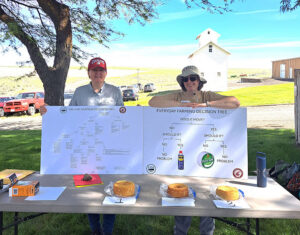
For the past three years, as part of a larger effort supported by the Foundation for Food and Agriculture Research to develop the new quick test for FN (Total Target for Sprout Damage; smallgrains.wsu.edu/ffar/), breeders and industry partners have been teaming up to refine how low falling numbers events are detected; utilizing integrated approaches for faster and earlier detection with real-time reporting; and across a broader landscape. Leveraging these partnerships allowed for the natural re-imagining of FN testing in both public and private variety trials with an emphasis on repeatable, consistent, and timely results.
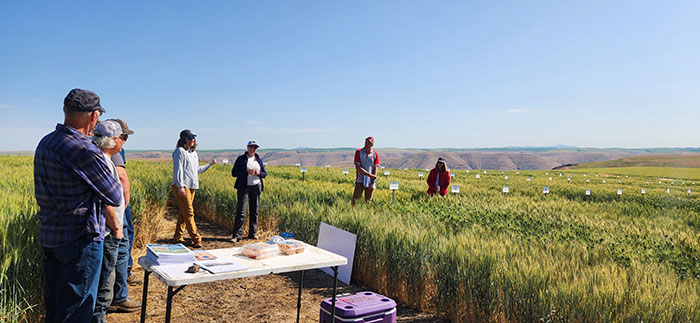
To address the needs communicated by the breeders and VT managers, four steps were implemented to improve FN testing in VT programs. Instead of testing every sample at every location, a Amber Hauvermale (left) and Alison Thompson talking about falling number management at the 2024 Lind Dryland Research Station Field Day in Lind, Wash. costly and time-consuming process, a targeted approach was used. The steps of the new approach are:
- Prescreen checks at all locations.
- All varieties from “hot spot” locations sent to the Washington State Department of Agriculture (WSDA) for FN testing.
- FN data reported out, usually within 48-72 hours after sample submission.
- Track and report “hot spots” over the years.
The prescreening step was conducted at all locations on a small set of “check” varieties inhouse, looking for low falling numbers “hot spots.” Check varieties are known to be susceptible or tolerant to differing causes of low falling numbers after many years of testing. The deviation in testing approach was based on previous research showing that the only way to accurately identify susceptibility is to test in low falling numbers environments. Moving to the WSDA, an agency with the infrastructure to handle screening thousands of samples each season, reduced overall costs and increased the number of samples that can be tested every year.
The strength in this effort lies in the scale (testing foot print) and partnerships across public and private testing groups. Variety trial programs are critical resources for testing performance, evaluating regional suitability, and providing comprehensive information to stakeholders. Screening check varieties across a large footprint provides a clearer picture of how low falling number issues develop across different environments and management practices. Early feedback about the new approach indicates that it has challenged previous assumptions about FN, and the information being provided is important and impactful.
Researchers are gaining a better understanding of where and when low falling numbers occurs, the extent of impact on management and end-use quality, and insights into how management, environment, and genetics influence plant responses. Breeders are gaining a better understanding of how new varieties respond to low falling number causes and select for tolerance.
Understanding low falling number risks translates to better management decisions, reduced risks, and minimizes financial losses for seed handlers and growers.
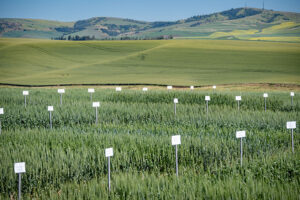
As low falling numbers continues to challenge PNW wheat production, integrated testing and coordinated efforts between public and private production and grain testing sectors is essential. By combining rapid testing innovation with efficient testing platforms, the PNW wheat industry is taking proactive steps toward protecting one of its most valued crops and providing a model for comprehensive wheat VT testing everywhere.
We are grateful for the many on-farm cooperators and variety trial managers we partner with to conduct these trials including those with Washington State University, Oregon State University, University of Idaho, HighLine Grain Growers, The McGregor Company, and McKay Seed Company. This effort would not be possible without their support.