
One of the pleasures of being a wheat breeder is talking directly with our growers. More than one grower this year has told me that it’s been a tough year with low prices, higher fertilizer and chemical costs, unstable weather, and other market forces that impact profits. As a public sector researcher, I am paid by tax dollars. I work for you, the people who grow the club wheat varieties I develop and the people who eat the products made from my club wheat varieties.
While I can’t influence market forces or the weather, I can bring the power of plant genetics to solve at least one of your problems: producing grain that is desired in the market. I develop club wheat varieties that are resistant to disease, producing good quality grain in diverse environments that also meet the high standards of our export customers.

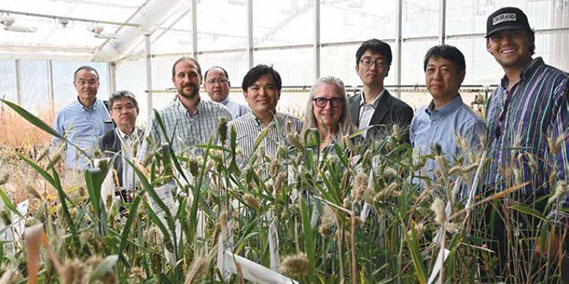
Another pleasure of being a wheat breeder is talking directly with our export customers. Through the efforts of U.S. Wheat Associates (USW) and the Washington Grain Commission, multiple trade teams visit the U.S. Department of Agriculture’s Agricultural Research Service (USDA-ARS) and Washington State University (WSU) facilities each summer. Our customers journey from Taiwan, the Philippines, Thailand, Japan, Korea, and South America to visit growers, grain elevators, and our research facilities in Pullman, Wash. Five trade teams and one technical team visited us in 2025, including three from Japan — the primary buyer of club wheat. During their October visit, this year’s Japanese Biscuit Association team informed me that Japan has been purchasing club wheat for at least 80 years. They now purchase club wheat in a typically 20% blend with soft white wheat, which is marketed as “Western White.”
Japan considers club wheat to be so valuable that they worked with USDA and the Washington Grain Commission to establish the Japanese Club Wheat Technical Exchange. Since 2019, each year, we send grain of our most promising breeding lines, along with currently grown club wheat cultivars and a Western White blend as checks, to the USDA Western Wheat Quality Lab where it is distributed to multiple Japanese flour milling companies. The Japanese labs evaluate milling quality, cookie and cake baking quality, taste, and texture before we meet in the summer to discuss results. Since the Club Wheat Technical Exchange was established, we have met in Tokyo, Pullman, and via Zoom. Our major customers have been able to walk through club wheat in the field. The USDA Western Wheat Quality Lab revised its sponge cake method to better match the Japanese method. We dropped two promising club wheat cultivars because they didn’t meet quality expectations, in addition to revising our selection methods. Since 2020, every promising club wheat variety that we have sent to Japan has passed their testing for good quality. This collaboration is critical to maintaining the market, especially as the PNW is the only place in the world where club wheat is commercially produced for export. The quality of club wheat is the foundation for Washington’s status as the supplier of high-quality grain.
Managing the production of club wheat has been a challenge. When the supply is adequate, the premium for club wheat vanishes. When the supply is low, the premium increases. At times, the premium has reached as high as $3 to $4. The premium was nonexistent for most of 2025, but has recently increased to about $.35. Unfortunately, when the premium is too high, the percentage of club wheat requested in the Western Wheat blend is lowered. Therefore, the market demand is best when club wheat achieves a significant, but not extraordinary, premium.
Naively, when I arrived in Pullman in 1999, I thought that developing club wheat varieties that were competitive with the best soft white wheat varieties would even out the fluctuations in the premium. I didn’t realize that overproduction of high-performance club wheats like Bruehl and Crescent in the 2008-2012 period would flatten the premium and necessitate off-loading club as feed wheat.
Even so, my goal is to develop club wheat varieties that are competitive with the best soft white varieties. The selection goals of the club wheat breeding program are to maintain and even improve the club wheat quality profile: low gluten strength, high break flour yield, high flour yield, and low water absorption. Growers and seed growers have many more choices of what soft white wheat to grow in 2026 than they did when I arrived in 1999. They don’t have bin room for more than one or two club wheat cultivars, which means the club wheat cultivars that are released by the USDA club wheat breeding program have to be widely adapted.
Currently, the club wheat varieties Pritchett and Castella each occupy about 50% of the club wheat acreage. Both varieties have excellent club wheat quality, with Castella delivering a yield advantage while Pritchett demonstrates better emergence from deep sowing. They are both resistant to stripe rust, but Castella has fewer problems with low falling numbers. Bruehl was a parent of Pritchett, contributing to low falling numbers. Castella has a very diverse pedigree that includes soft red winter wheat lines from New York and Arkansas. In addition to problems with lodging due to its tall height, Castella is awnless (without bristles on the wheat head), which can cause issues with game feeding and lodging.
While most of the club wheat production arcs between Lind, Odessa, Douglas, and Harrington, Wash., there are several growers on the Palouse who consistently plant club wheat. We recently released Cameo, the product of another diverse pedigree that includes parents from the eastern soft red market class. These parents contribute to Cameo’s excellent disease resistance, including eyespot and stripe rust, the major diseases impacting wheat in Eastern Washington. Cameo has good standability and performs best on the Palouse in Idaho and Washington. Growers who want to take advantage of a good premium also have the option of planting spring club wheats developed by Mike Pumphrey. Melba is a traditional spring club, and Hedge CL+ has the two gene imazamox resistance trait, useful for replanting onto ground where group 2 herbicides were previously used.

In 2026, we are proposing a new winter club variety, ARS14X1114RS3-CBW, for release as a Castella replacement. This new variety is shorter, has awns, and is competitive with soft white wheat cultivars throughout the region. Ironically, one of its parents is Xerpha, a poor-quality soft white winter wheat. Some of you will remember that Xerpha did yield well, although problems with stripe rust and grain quality could take it down. By crossing Xerpha with club wheat, we’ve managed to keep its yield potential in a high quality and disease resistant background.
Interest in herbicide resistant wheat cultivars is on the rise. After a major crossing project, Dr. Arron Carter and I have several herbicide resistant winter club wheat cultivars in the WSU variety testing trials this year. One of our favorites is ARS18X376-16CBW CL+, derived from a cross between Stingray CL+ and Castella. We have this line and three others in the traited nursery with the WSU variety testing program, with multiple trials sprayed with Beyond
herbicide to justify our release decisions.
We have also been working on Co-AXium (Co-AX) Herbicide club wheat cultivars. The Co-AX trait came to us as a hard red winter wheat from Colorado. Dr. Carter has done a great job of moving the Co-AX trait into high-quality soft white winter wheat. Nova-AX is a good example. However, moving Co-AX to club wheat is a tougher challenge. We have lines in multiple environments and in spray trials in 2025 and expect that some of these will be competitive enough for variety trial testing in 2027.
The members of the Japanese Biscuit Association pointed out that wheat growers are paid based on delivering clean, high test weight, weed-free grain to the elevator, but that they aren’t paid for the various quality characteristics. They wanted to know why we emphasized quality to the extent that we do. Wheat grower and former commissioner Brian Cochrane had a great answer. “Quality,” he said. “It’s all quality. We know you can go elsewhere for your wheat. We want you to come to us.”