
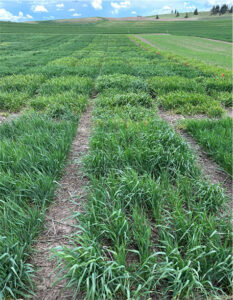
Weeds are among the most significant yield-limiting factors in winter wheat production in the Pacific Northwest, competing with the crop for water, nutrients, light, and space. The winter wheat–fallow and spring crop–legume–winter wheat cropping systems that have been adapted to different wheat-producing regions of Washington state are contributing to the development of herbicide-tolerant weed populations. In-season applications of Group 2 herbicides have been used for decades in the Pacific Northwest to control weeds in both wheat and legumes, and the overuse of this technology has led to the emergence of weed populations resistant to Group 2 herbicides.
As resistance spreads, growers face yield losses and narrowing options for effective, in-season control. To mitigate the formation of herbicide-resistant weed populations, alternative modes of action must be incorporated into Pacific Northwest wheat production systems. The incorporation of multiple herbicide modes of action in a crop rotation has been shown to result in better weed suppression than using only one herbicide mode of action, and many studies have found that diversifying crop rotations reduces the number of herbicide-tolerant weed populations (Anderson, 2005; Benaragama et al., 2016; Ulber et al., 2009). Putting these strategies into practice depends on the availability of regionally adapted wheat varieties carrying tolerance to a diverse set of herbicide chemistries. The Washington State University (WSU) winter wheat breeding program is addressing this need by developing varieties with tolerance to herbicides
representing multiple modes of action, including Group 1 (quizalofop), Group 2 (imazamox), and Group 5 (metribuzin) chemistries, giving Washington growers the tools needed to rotate effectively among modes of action, manage existing resistant weed populations, and slow the development of new ones.
Imazamox is an imidazolinone herbicide used to control problem grass weeds in winter wheat, but its use is limited to Clearfield (imidazolinone-resistant) varieties. It works by inhibiting an enzyme called acetolactate synthase, or ALS, which plants need to produce essential amino acids. Without those amino acids, susceptible weeds cannot grow. Clearfield wheat carries a small genetic change that allows its ALS enzyme to continue functioning in the presence of the herbicide so the crop is unharmed while target weeds are controlled. This resistance trait was originally developed in the early 1990s and has since been incorporated into varieties adapted to regional growing conditions. Imazamox provides control of several economically important grass weeds, and application timing and rate are critical to success. Spraying too early may allow late-germinating weeds to escape control, whereas spraying too late may permit yield damaging weed competition. Producers should also avoid exceeding labeled rates. The resistance conferred to Clearfield wheat is partial; only about two-thirds of the crop’s ALS enzyme is protected from the herbicide, so excessive rates can cause crop injury even in tolerant varieties. Some of the released cultivars from WSUinclude Stingray CL+, Sockeye CL+, and Piranha CL+.
Quizalofop, sold under the trade name Aggressor, is the herbicide developed for use within the CoAXium wheat production system. Like imazamox, it is used to control grass weeds in winter wheat, but it operates through a different biochemical pathway. This difference makes it a valuable complement to Group 2 chemistry, particularly for resistance management. Quizalofop inhibits acetylCoA carboxylase, or ACCase, the enzyme responsible for fatty acid and lipid synthesis. When ACCase activity is blocked, cell membranes in susceptible grass weeds lose integrity, leak their contents, and the plant dies. CoAXium wheat varieties carry a mutation in the ACCase gene that protects the crop’s enzyme from the herbicide. Symptoms of quizalofop injury on nontolerant wheat include reduced plant height, yield loss, and characteristic streaky chlorosis on young leaves. Like Clearfield tolerance, growers must pay attention to application timing and rate and ensure temperatures are above the minimum listed on the label to prevent excessive injury. WSU released cultivars include Nova AX and an upcoming release numbered WA8444 AX.
Metribuzin is a Group 5 herbicide that controls weeds by inhibiting photosynthesis at photosystem II, effectively preventing the plant from converting sunlight into energy. Tolerance to metribuzin is a naturally occurring trait that varies among wheat varieties.
Application to a sensitive variety can result in crop injury, with symptoms including stunted growth, reduced tillering, leaf chlorosis, and reduced grain yield. The severity of injury depends strongly on application rate and environmental conditions at the time of treatment. Despite these limitations, metribuzin offers two important advantages. First, it provides an alternative mode of action to Group 1 and Group 2 herbicides, which is increasingly valuable as resistance to those chemistries spreads. Second, research conducted in Washington demonstrated that Italian ryegrass populations were more susceptible to metribuzin than to the Group 1 and Group 2 herbicides tested, suggesting that metribuzin can effectively control grass weeds that have escaped other products (Rauch et al., 2010). Because tolerance already exists in some released wheat lines, conventional selective breeding is being used to develop metribuzin-tolerant varieties. Rydrych MZ, released from WSU, can tolerate the highest label rates of metribuzin, allowing for effective weed control with limited crop injury.
In partnership with the University of Idaho, a Brundage mutation population of over 10,000 lines is being grown to increase seed quantity. Once seed is harvested, it will undergo selection for tolerance to many different modes of action that would be effective in Washington cropping systems. This method is similar to how the Clearfield and CoAXium wheat systems were identified, using mutations in enzymes to provide tolerance. With the limited introduction of new herbicides into the market, finding mutations that allow wheat to survive current herbicides will be an effective way to control weeds, use different modes of action, and slow the development of herbicide-tolerant weeds. Although the discussion in this article has been around the use of herbicides to control weeds, this should not be the only method. Growers need to continue to control weeds through cultural practices, crop rotations, tillage (when necessary), and planting weed-free seed. Using these practices, along with a good rotation of herbicide mode of action, will reduce the probability of weeds developing herbicide tolerance.
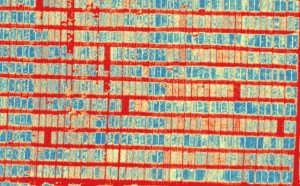
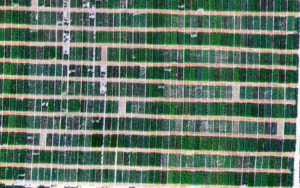
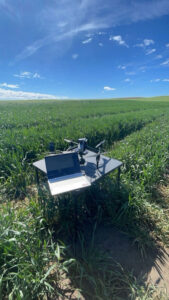
The WSU winter wheat program is also exploring the use of a drone-mounted sensor to measure herbicide injury in winter wheat breeding plots. This technology is currently being used to measure herbicide injury in breeding lines for metribuzin and quizalofop resistance. Traditionally, herbicide injury is assessed through visual ratings, which can be individually biased, and injury ratings do not always correlate with grain yield at harvest. The drone mounted sensor overcomes these limitations by capturing wave lengths of light invisible to the human eye, allowing it to detect plant stress before symptoms become visually apparent. These projects have revealed that flying plots at multiple time points after herbicide application can be used to quantify injury severity and identify tolerant lines earlier in the breeding cycle, providing breeders with objective, repeatable measurements that can better capture the grain yield penalty after application.
Herbicide-resistant weed populations represent one of the most pressing challenges facing winter wheat producers in the Pacific Northwest, and no single herbicide or wheat variety will solve the problem. By developing winter wheat varieties tolerant to herbicides representing three distinct modes of action, Group 1 (quizalofop), Group 2 (imazamox), and Group 5 (metribuzin), the WSU winter wheat breeding program is equipping growers with the diversity of tools needed to rotate chemistries, manage existing resistant weed populations, and slow the emergence of new ones. Coupled with advances in drone-based phenotyping, which allow herbicide tolerance to be measured more objectively and earlier in the breeding cycle, these efforts will help ensure that effective, sustainable weed control remains within reach for wheat producers for years to come.