Club wheat exchange ensures collaboration between researchers, customers
When it comes to specialty wheat classes, club wheat holds a unique place in Washington’s export portfolio. While it only accounts for about 5% of Washington’s production, club wheat stands out in global markets, but not for its yield or agronomics. Instead, club wheat is sought after for its unparalleled end-use quality, and that’s where the Club Wheat Technical Exchange comes in. A direct collaboration between U.S. breeders and Japanese millers, the Club Wheat Technical Exchange ensures the characteristics of Washington’s club wheat stay in sync with the quality standards of its most discerning customer.
What is the Club wheat Technical Exchange?
Unlike standard trade teams, the Club Wheat Technical Exchange is not directly focused on sales and marketing. Since its launch in 2018, the exchange has served as a technical, variety-development partnership between:
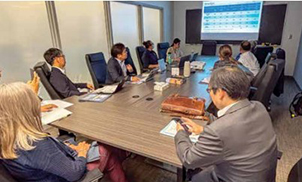
Members of the Japan Flour Millers Association review club wheat breeding data with U.S. researchers during the 2025 Club Wheat Technical Exchange, held in Pullman, WashingtonU.S. Department of Agriculture’s Agricultural Research Service’s (USDA-ARS) Western Wheat Quality Laboratory in Pullman.
Japan Flour Millers Association (JFMA)
Washington Grain Commission (WGC)
Washington State University
Each year, a selection of club wheat breeding lines from Pullman is shipped to Japan, where millers grind, mill, bake, and analyze the lines against strict quality Bridging breeding and baking standards. Once tests are complete, members from each organization meet to share results, equipping U.S. breeders with direct customer feedback to decide which lines to advance. This two-way dialogue aligns breeding decisions with real market needs and has resulted in the release of several high-performing varieties tailored to Japanese quality standards and preferences.
The 2025 exchange: Strengthening technical collaboration
From Sept. 14–16, 2025, Washington hosted the latest iteration of this program, jointly organized by USDA-ARS, JFMA, and WGC, with assistance from U.S. Wheat Associates in Tokyo. The 2025 exchange brought Japanese milling and research representatives to Eastern Washington where they directly reviewed variety performance, observed trial plots, and met with breeders and quality specialists. Participants discussed milling and baking performance, blending ratios between club and soft white, and target thresholds for moisture absorption, crumb structure, and finished-product texture. The exchange again demonstrated that this program goes beyond the strong marketing focus of traditional trade teams, instead centering a scientific, quality-driven collaboration that directly informs the next generation of breeding decisions and, therefore, the next generations of Washington club wheat purchases. This year, all the varieties tested by the exchange met the JFMA quality standards and will advance in the breeding process.
Why club wheat matters to Japan — and Washington
Western White (WW) wheat, commonly used in confections like sponge cakes, cookies, and crackers, is typically a blend of soft white (SW) and 10% white club wheat. But for Japanese blends of WW, club wheat often comprises 20% or more of the mix. Produced primarily in Washington, this blend holds over a 90% share of Japan’s confectionery flour market.
For Japanese millers and bakers, club wheat delivers a “melt-in-the-mouth” texture without added fats, something that, in the U.S., usually requires higher shortening content. As wheat quality expert Art Bettge notes, the same unique starch and protein characteristics that make club wheat valuable overseas could also help U.S. food manufacturers develop healthier, lower-fat products if adopted more broadly.
Japan’s ongoing commitment
Japan remains one of Washington’s most consistent and quality-focused customers. In marketing year 2024-25, Japan was the third-largest buyer of Washington soft white wheat, purchasing 25.11 million bushels (683,000 metric tons (MT)), a 7% increase from its five-year average of 23.46 million bushels (638,000 MT).
As of Sept. 18, year-to-date sales of soft white to Japan totaled 12.79 million bushels (348,000 MT), also up 7% year-over year. Japanese buyers consistently value Washington’s soft white and club wheat for its reliability and premium quality, particularly for high-end confectionery and snack products.
Washington’s sustained and substantial Japanese market share underscores the impact of the Club Wheat Technical Exchange. By aligning breeding goals with Japan’s quality expectations, this initiative not only strengthens buyer confidence but also ensures the Western White blend continues to meet the specifications of Japan’s milling and baking sector.
A model for collaborative wheat development
For Washington’s wheat industry, the Club Wheat Technical Exchange represents the best of what market-driven research can accomplish. By linking field trials to flour performance and connecting breeders to customers, the exchange bridges two ends of the value chain, on opposite sides of the Pacific Ocean.
Through programs like this, Washington growers don’t just plant seed, they invest in long-term trust, partnership, and market sustainability. The result is a product that performs as well in a Pullman test plot as it does in a Tokyo bakery.
This article originally appeared in the November 2025 issue of Wheat Life Magazine.
Jake Liening
Market Development Specialist Washington Grain Commission