Washington’s spring cereal grain production in 2025 was once again dominated by the seasonal timing of high temperatures and unreliable precipitation during the growing season. The 19.7 million bushels of spring wheat harvested was down 6% compared to 2024, but near the five-year average. Yields averaged 42 bushels per acre, and milling quality specifications were generally good with stable test weights and reasonable protein considering the noted lack of moisture through most of the growing season.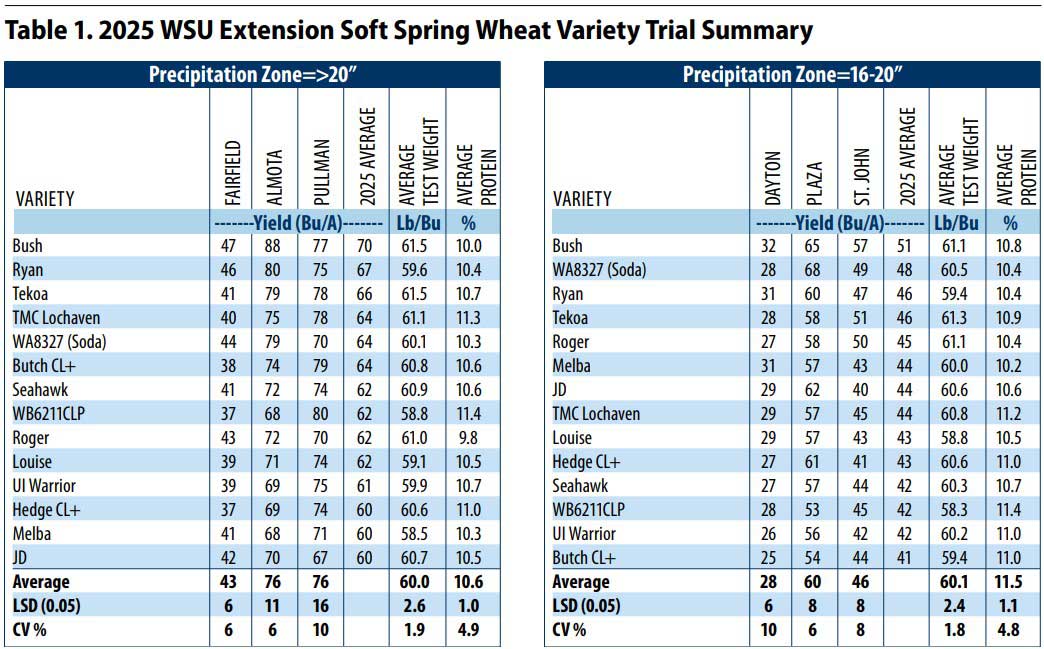
Acreage reporting from the National Agricultural Statistics Service (NASS) estimated 80% of Washington’s spring wheat acres were soft white market class, and a total of 910,000 spring wheat acres were seeded in Washington and Idaho. Barley acres harvested dropped significantly to 49,000 in Washington, while Idaho harvested 490,000 acres.
The Washington State University (WSU) Variety Testing Program successfully conducted spring wheat trials at 12 locations across Eastern Washington in 2025. Testing data is intended to provide rain-fed wheat growers with unbiased information on variety performance and relevant traits to help support optimal on-farm production, provide samples for rigorous end-use quality evaluation, allow comparison to new and up-and-coming variety candidates, and support market class production decisions. Variable production conditions limited our ability to use results from five additional locations where yield data were not sufficiently reliable, mostly in lower precipitation areas that were strongly affected by low rainfall and untimely heat. 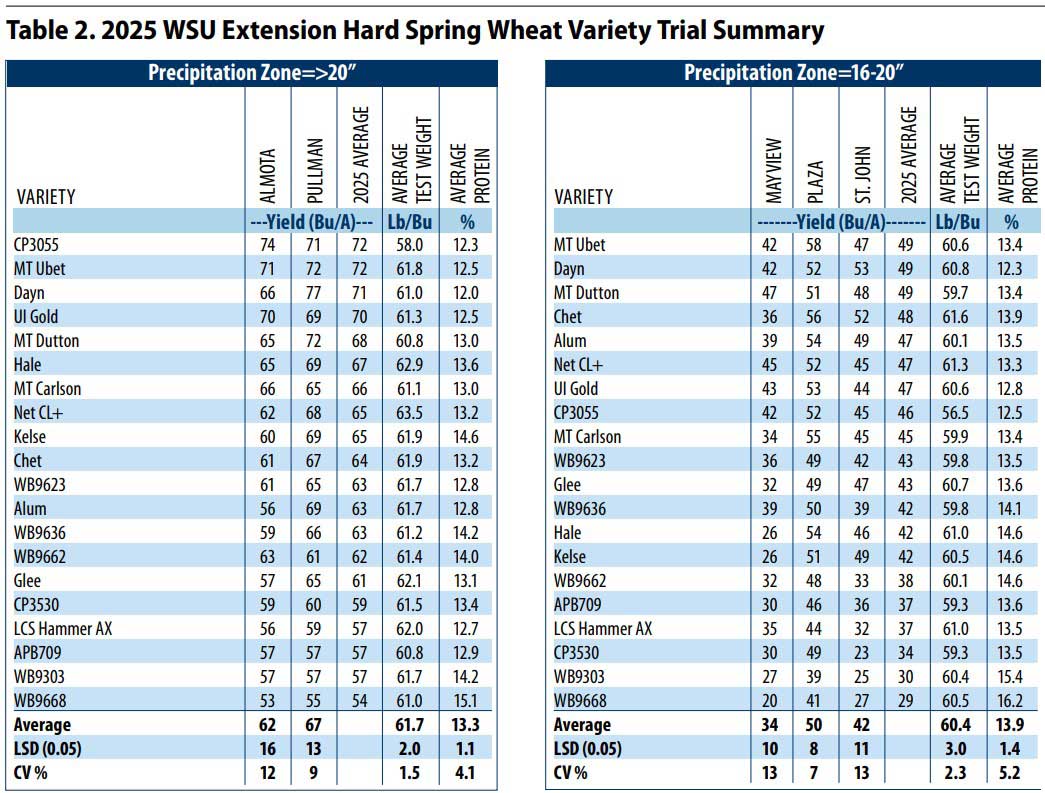
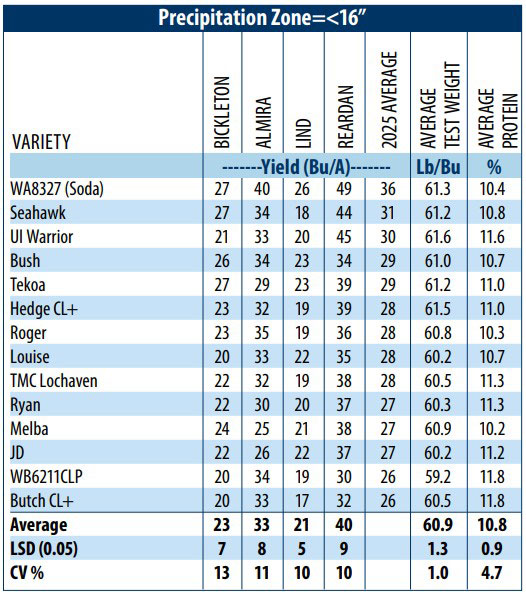
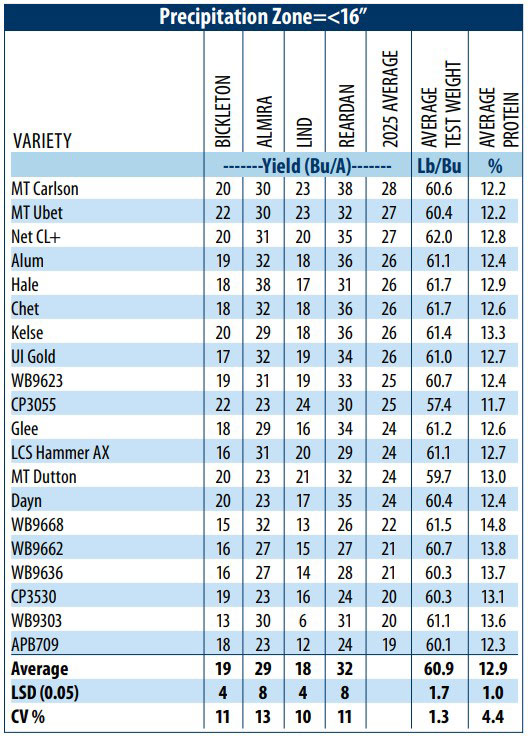
Data in Tables 1 and 2 summarize rain-fed trial performance of commercially available varieties. Summaries of experimental cultivars, irrigated nurseries, and less reliable dryland locations are not presented but are available on the WSU Small Grains Extension website at smallgrains.wsu.edu using the Variety Selection tool. Data on quality rankings, falling numbers, pest and disease resistance, aluminum tolerance, plant height, heading date, and other traits are available from WSU Extension as well as from the Washington Grain Commission, the U.S. Department of Agriculture’s Agricultural Research Service’s Western Wheat Quality Laboratory, or the WSU wheat breeding team.
The rankings of top performing soft white varieties in each precipitation zone were consistent with the performance in 2024 and prior years. Bush, a 2024 release from WSU, Ryan, Tekoa, and a 2025-release, Soda (WA8327), performed well across precipitation zones. Roger was the leader in spring club wheat performance, with yield averages very similar to Ryan across locations.
Hard spring wheat varieties were planted on about 20% of the spring wheat acres in Washington in 2025, based on NASS reporting. Performance of hard red spring varieties was more variable, with no clear statistical separation in variety performance, though MT Ubet and MT Dutton trended higher yielding across precipitation zones.
Herbicide tolerant two-gene Clearfield cultivars in the spring wheat variety trials included Butch CL+ (SWS), WB6211CLP (SWS), Hedge CL+ (spring club), Net CL+ (HRS), and experimental line WA8436 CL+ (HRS). LCS Hammer AX (HRS) was the only CoAXium spring wheat in the Variety Testing Program trials.
 Barley yields in Washington were sharply lower in 2025, with a NASS estimate of 49 bushels per acre, with seasonal drought and temperature effects clearly impacting the crop. See Table 3 on the next page. Like hard red spring wheat, compressed yields and challenging environmental conditions led to few statistically significant differences among variety yields, though LG Slovan, KWS Thalis, Carleton, Claymore, LG Caruso, and KWS Enduris trended toward the top of yield performance.
While a summary of 2025 data is presented in this article, growers are always encouraged to spend more time looking at multiyear data for a better representation of variety performance when available. Additional information, ratings, and yield data can be found at our website at smallgrains.wsu.edu/variety.
Acknowledgements: Funding for 2025 for supplies, travel, and technical support (Alex Brown and Karl Effertz) for the WSU Extension Cereal Variety Testing Program was provided by the Washington Grain Commission and WSU Wheat Breeding Royalty and USDA-ARS Club Wheat Breeding funds. Facility and partial salary support were provided by WSU. We are grateful for the many on-farm cooperators we partner with to conduct these trials around the state. They are essential for producing quality data, and their donations of land, time, and resources are appreciated.