
This year, stable overall production and increased supplies have positioned U.S. wheat as a reliable and competitive option for buyers. While total U.S. production of all wheat classes is slightly down compared to last year, production is higher than the five-year average. Buyers around the world have recognized the excellent value U.S. wheat offers, as current price levels are making high-quality wheat more accessible.
As the top producers of soft white wheat in the U.S., Washington, Oregon, and Idaho have a reason to be proud. The 2025 Crop Quality Report highlights how the PNW’s commitment to both responsiveness to buyers’ needs and quality continues to drive success shared by farmers, USW, and the entire U.S. wheat industry.
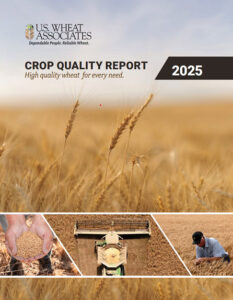 Throughout the PNW, farmers worked extremely hard to balance weather, timing market conditions, and everything else involved in agriculture to produce another high-quality soft white wheat crop. As always, USW takes a deep dive into soft white in the 2025 Crop Quality Report. Some of the highlights for soft white wheat:
- Soft white production is estimated at 7 million metric tons (259 million bushels), up 4% over last year.
- Soft white experienced good moisture and moderate temperatures during the first part of the growing season, followed by drier conditions later in the year. This resulted in a wheat crop with a more typical protein distribution.
- This year’s soft white crop has appropriately weak-to-medium gluten strength and produces finished products with acceptable to-good characteristics.
- Soft white wheat is used in cakes, pastries, cookies, and snack foods. The higher protein portion of this year’s crop can be used in blends for crackers, Asian noodles, steamed breads, flat breads, and pan breads.
- Soft white wheat test weight averages trended higher, with all protein composites above 60 pounds per bushel (78.9 kg/hectoliter).
- Wheat protein averages are slightly higher than last year due to less moisture late in the growing season; both remain within normal range.
- Wheat ash is significantly lower in soft white compared to last year and the five-year average due to drier conditions late in the growing season.
- Falling number averages exceed 300 seconds. Soft white is slightly below the five-year average due to localized freeze events during grain filling.
- Soft white dough shows typical properties, ranging from very weak to medium gluten strength and low water absorption.
This is the 46th year of USW’s Crop Quality Report. As previously mentioned, farmers play a key role in building this valuable report. Each year, samples are collected during wheat harvest, starting in spring and ending in late summer. These samples are sent to USW’s six partner laboratories across the U.S., where rigorous testing and analysis are conducted. The results are then compiled into the final product.
Even after 46 years, USW is still working to improve the report. This year’s edition includes several updates, including the introduction of new sponge cake data to provide more end-product performance information. Additionally, USW has separated the analysis methods into a standalone document, allowing more context and clear definitions for each test.
The full report is available on the USW website (uswheat.org). Regional reports and translated versions will also be accessible in Arabic, Chinese, French, Spanish, Italian, and Portuguese.
Again this year, USW is conducting Crop Quality Seminars around the world to share this year’s report with U.S. wheat customers. The seminars, which began in early November, will run through December in North Asia, South America, Europe, South and Southeast Asia, sub-Saharan Africa, Mexico, Central America and the Caribbean, the Middle East, and North Africa.
USW encourages all wheat farmers to read the 2025 Crop Quality Report and to remember that customers around the world depend on it to provide valuable information about the world’s most reliable wheat.